
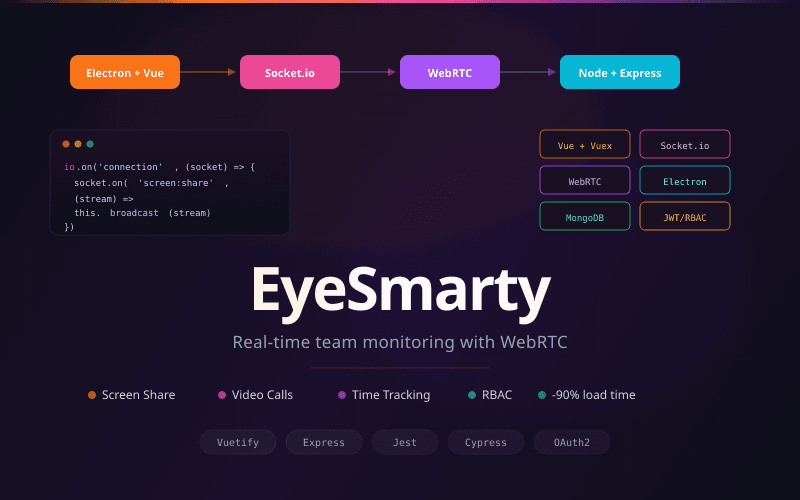
EyeSmarty
EyeSmarty is a desktop and web-based time tracking application designed for remote teams. I worked across the entire stack — designing and implementing real-time screen monitoring, live audio/video calls via WebRTC, and detailed time reporting dashboards. The desktop client was built with Electron and Vue (Vuex + Vuetify), while the backend ran on Node.js with Express and MongoDB. Socket.io powered real-time communication between clients and the server. I implemented secure JWT authentication with refresh tokens and role-based access control to protect sensitive monitoring data. On the quality side, I increased test coverage with Jest and Cypress integration tests, which shortened QA cycles. The biggest win was optimizing the codebase to reduce page load times by 90%.
Technologies
Key Highlights
- Built real-time screen monitoring and audio/video calls with WebRTC and Socket.io
- Optimized codebase reducing page load time by 90% with secure RBAC and JWT auth
Engineering Challenges
Why We Ripped Out Socket.IO for Audio/Video and Replaced It with WebRTC
Audio and video calls were originally built on top of Socket.IO — the server relayed media streams between clients. It worked in testing, but under real usage with multiple concurrent calls, CPU and memory on the server spiked, audio cut out every few seconds, and video froze or dropped entirely. Debugging pointed to a single root cause: every byte of media was passing through our Node.js server. Socket.IO is a messaging layer — it was never designed to carry continuous high-bandwidth media streams. The fix was migrating to WebRTC, which establishes direct peer-to-peer connections between clients. The server steps out of the media path entirely and only handles signaling (who wants to call whom). After the migration, server load during active calls dropped by over 80%, audio/video latency fell from 800ms+ to under 150ms, and call quality remained stable even with six or more participants.